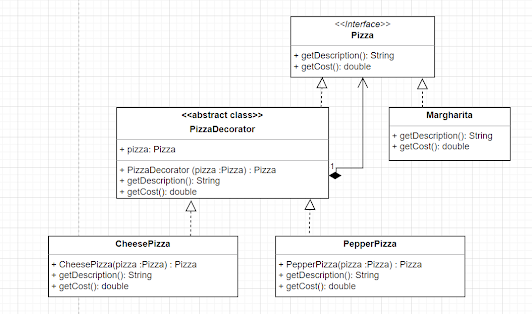
The Decorator Design Pattern is a structural design pattern that allows behavior to be added to an object dynamically at runtime by wrapping the object in a decorator class. It provides an alternative to subclassing for extending functionality. Key Components of the Decorator Design Pattern: Component: It is the common interface or abstract class that defines the operations that can be performed by the objects and decorators. Concrete Component: It represents the original object to which additional behavior will be added. It implements the Component interface. Decorator: It is an abstract class that implements the Component interface and has a reference to the Component object. It acts as a wrapper and provides a default implementation for the Component's operations. Concrete Decorator: It extends the Decorator class and adds additional behavior to the Component object. It overrides the Component's operations and may call the super implementation to preserve the original beha...
The Bridge Design Pattern consists of the following components: Abstraction: This is the high-level abstraction that defines the interface and maintains a reference to the Implementor. It provides higher-level operations that are built on top of the Implementor's operations. Refined Abstraction: This is a subclass of the Abstraction that extends or refines the abstraction's interface. It can add additional operations or modify existing ones. Implementor: This is the interface that defines the operations that can be performed by the concrete implementations. It provides a separate interface for different implementations. Concrete Implementor: These are the concrete classes that implement the Implementor interface. Each concrete implementor provides a specific implementation for the operations defined in the Implementor interface. The Bridge Design Pattern promotes loose coupling between the Abstraction and the Implementor by separating the two into separate class hierarchies. ...

Comments
Post a Comment